 admin
admin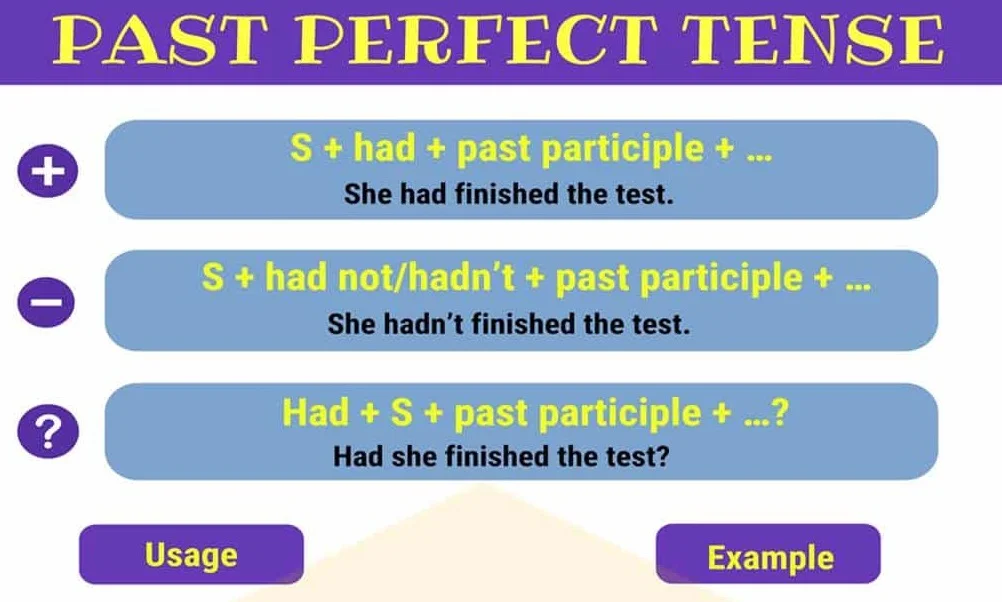
The past perfect tense is used to indicate an event that occurred before a specific time in the past and emphasises the fact rather than the duration.
The past perfect tense is formed with the auxiliary verb had and the past participle (verb-3). Had is used for both singular and plural subjects. The past participle is formed by adding –ed, -en, -d, -t, -n, or -ne to the base form of a regular verb.
Formula
(+) Positive: Subject + Had + V3 + Object
(-) Negative: Subject + Had + Not + V3 + Object
(?) Interrogative: Had + Subject + V3 + Object?
Example Sentences
When he came last night, the cake had run out.
The student had gotten a verbal warning before his parents were called.
I had already eaten my breakfast by the time he picked me up.
Prior to the proclamation, Indonesia had been colonised by Japan for 3 years.
Past Perfect Continuous Tense
Similar to the Past Perfect Tense, the Past Perfect Continuous Tense is used to express an action that occurred in the past and had been completed at a certain point in time in the past. The difference is that the Past Perfect Continuous Tense emphasises the duration of the event.
The Past Perfect Continuous Tense is formed with the auxiliary verbs had and been and the present participle. In general, the Past Perfect Continuous Tense only occurs with dynamic or action verbs, not stative verbs, because generally only dynamic verbs have a continuous form.
Formula
(+) Positive: Subject + Had + been + Ving + Object
(-) Negative: Subject + Had + Not + been + Ving + Object
(?) Interrogative: Had + Subject + been + Ving + Object?
Example Sentences
She was annoyed since she had been waiting for 2 hours at the bus station.
By the time the teacher came, the students had been reading half of the text.
I had been working with my computer all day, and all I wanted to do was eat some chocolate.
